

Preparing for Change: Knowing Who’s With You and Who’s Not
When you’re leading change, it’s natural to focus on the work itself—the strategy, the plan, the timeline. But there’s another layer that often determines whether change succeeds or stalls: the people.
Every change effort has stakeholders—people who will be affected, people who hold influence, people whose support you’ll need. And here’s what makes this tricky: not everyone sees the change the same way you do. Some will champion it. Some will resist. Many will wait and watch.
Effective change leaders possess a sensitivity to their stakeholders. We recognize it in those leaders who somehow know whom to talk to, to whom they should listen, and which conversations matter most. They seem to know what’s going on—and they base their actions on the longer-term perspective rather than short-term advantage.
This awareness isn’t magic. It comes from taking time to identify, map, and mobilize your stakeholders deliberately.
Three Steps to Working With Stakeholders
Stakeholder Identification: Who are the people and groups with a stake in this change? What are their interests—financial, operational, strategic, reputational? And what power or influence do they hold relative to your change effort?
Stakeholder Mapping: With your stakeholders now identified, you can assess where each one stands in relation to two key questions: Is this stakeholder supportive or resistant? And do they hold high or low power in this situation? This reveals who needs close attention, who needs to be kept informed, and who should be monitored from a distance.
Stakeholder Mobilizing: With identification and mapping complete, you’re able to strategize… How will you engage supporters to champion the change? How will you address concerns from skeptics? What will you do about those who are undecided?
The Value of Doing This Together
Stakeholder mapping is most powerful when done collaboratively. Your colleagues see relationships and dynamics you might miss. One person knows that a key director is privately skeptical. Another recognizes an unexpected ally in a different department. By pooling your observations, you build a more complete and honest picture—one that can guide your actions as the change unfolds.
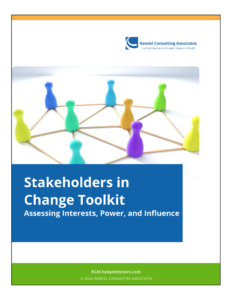
I’ve prepared a Stakeholder Mapping Toolkit to help you work through these three steps with your team. It includes identification worksheets, a mapping framework, and mobilizing strategies for different stakeholder situations.
Download the toolkit with ideas for each step.
Ready to Go Deeper?
Developing insights into your stakeholders benefits from additional perspectives – especially those from an outsider!
- If you want to explore what it can look like to have support, book a complimentary 30-minute strategy call.