

Dear Change Leader,
“I realized I hadn’t looked up in about six months,” Naomi told me.
Naomi is the VP of Operations at a regional logistics company. After a merger, she was handed the job of integrating two teams, two systems, and two ways of doing almost everything. She did what had always worked for her: she dove in. She fixed scheduling conflicts, smoothed vendor disputes, and sat in on tense client calls. Her team valued her, and everything was busy.
But the same issues kept coming back in new forms. And her people had quietly stopped making decisions without her.
Then she overcorrected. She cleared her calendar for “big-picture thinking” and started working from the sidelines. Within a month, her team felt abandoned, and the rumor mill took over.
Two Places to Get Stuck
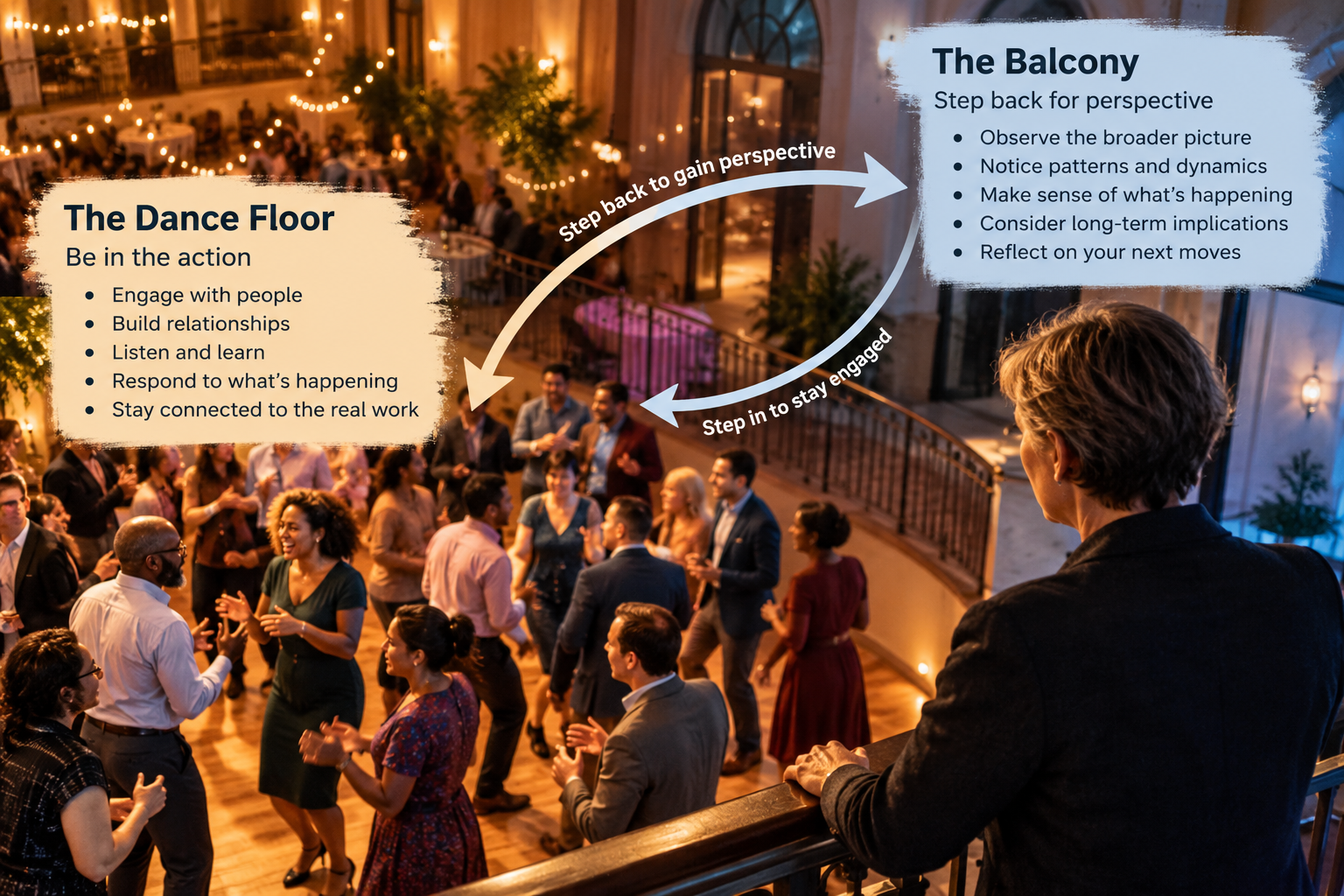
Ron Heifetz, whose Adaptive Leadership class at Harvard’s Kennedy School is highly regarded, calls this the leader’s central balancing act. His metaphor is that of a dance floor and a balcony.
On the dance floor, you’re in the action: building relationships, listening, responding, staying close to the real work. On the balcony, you step back and look at the whole room. You notice patterns, make sense of what’s happening, and think about where it’s all heading.
Neither place is the right one. Leaders get stuck in one or the other, and each has a cost.
- Stuck on the dance floor, you’re so absorbed in the music that you can’t see where the room is heading. You solve today’s problem and miss the pattern behind it.
- Stuck on the balcony, you see clearly but lose touch with the people and the work. Your insights go stale, and trust weakens.
Why This Matters More in Times of Change
Heifetz distinguishes between technical problems, which have known solutions that expertise can deliver, and adaptive challenges, which require people to learn, shift priorities, and sometimes let go of familiar ways of working.
Most of us were promoted because we were excellent at technical problems. So when change arrives, the instinct is to dive in and fix things. But adaptive challenges don’t yield to fixing, and no one else has the answer either. What helps is the ability to move: close enough to understand, far enough to see.
If that sounds like the skill you’re still building, you’re in good company.
Three Practices for Staying Nimble
- Notice your default.
Most of us have a home position. Are you the leader who can’t resist jumping in, or the one who retreats into analysis when things get messy? Your team probably knows already.
This week: Look back at your last five days. Roughly how much time did you spend in each place? Where did you stay too long?
- Schedule the balcony.
It rarely happens on its own, especially if you’re a dance-floor person. Build it in, even in small doses. Ask yourself:
- What patterns keep showing up?
- Who’s speaking, and who’s gone quiet?
- What might be going on beneath the stated issue?
This week: Block 20 minutes, with no screen and no agenda. Ask those three questions about your most persistent challenge.
- Come back down with something.
A balcony view is only useful if it changes what you do next. If you’ve been on the sidelines, return to the floor with one conversation or experiment that tests what you saw.
This week: Pick one thing you noticed from the balcony and take one small action on the floor within 48 hours.
Back to Naomi
Naomi didn’t need to choose between being close and being clear. She started blocking a short weekly “balcony hour,” and each time she came back down with one question to explore with her team rather than one more problem to solve. Within a couple of months, two of her managers were resolving issues she once would have taken on herself.
The room hadn’t gotten any calmer. But she was moving through it with more choice.
Until next time,

P.S. If you suspect you’ve been stuck in one spot, on the floor or on the balcony, I’d be glad to think it through with you. Simply reply to this email.
Recent Articles
Read other editions of this newsletter for further insights:
“The Perspectives That Shift Everything“: On how our position in the system creates blind spots, and practical ways to see what you can’t see from where you sit.
“The Art of Dynamic Balance“: Why staying steady in complex environments takes constant small adjustments, not stillness.
“You’re Not Meant to Lead Alone“: Why the isolation leaders feel is common and unnecessary, and how to find the peer support that gives you a view you can’t get alone.
EFFECTIVE CHANGE RESULTS FROM INTENTIONAL LEADERSHIP
We’re a leadership and organization development consultancy. My team and I work with leaders like you to prepare for and lead successful change processes.
Here’s why our clients call us:
- Leadership Coaching: I support leaders as they navigate transitions into new roles or expanded responsibilities.
- Group Programs: Bringing groups of leaders together, I facilitate learning experiences and months-long programs that equip people to be effective change leaders.
- Effective Teams and Organizations: I work with leaders and their teams with tailored processes that increase their effectiveness, building layers of aligned teams that transform organizations.