
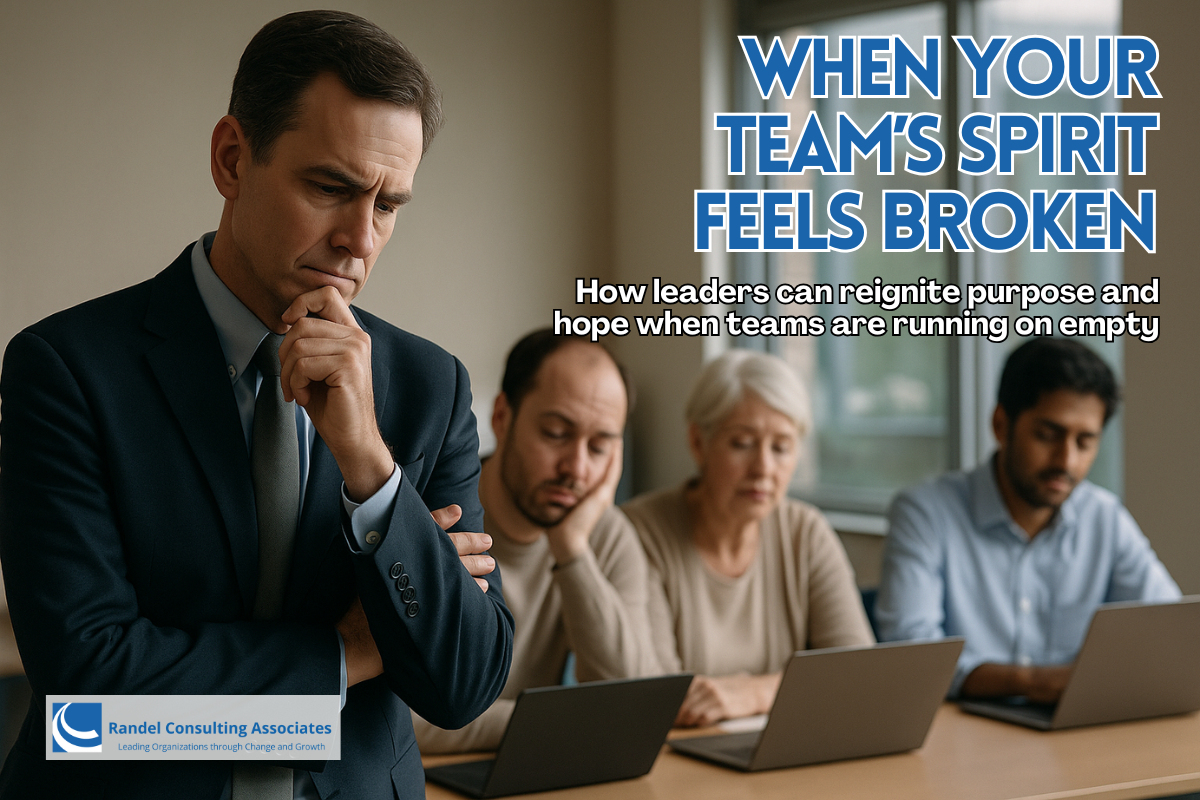
How leaders can reignite purpose and hope when teams are running on empty
Dear Change Leader,
“I look around the room and see people who used to light up when we talked about our work,” Stefan shared with me last week. “Now they just look… tired. Really tired.”
As Executive Director of a community health organization, Stefan had watched his team navigate eight months of uncertainty. Budget cuts had eliminated two positions. Regulatory changes that tripled their reporting requirements. Most recently, a major funder pulled out, forcing another round of difficult conversations.
His team had responded with professionalism. They’d absorbed extra work, adapted to new procedures, and maintained service quality despite the challenges. But Stefan could see something had shifted.
“They’re still doing the work,” he continued, “but the energy, the sense that we’re making a real difference—it feels like that’s just… gone.”
Stefan realized his team wasn’t just tired—they were discouraged.
The Weight of Sustained Uncertainty
If Stefan’s situation sounds familiar, you’re not alone. Leaders across sectors are describing similar dynamics: teams that have weathered months of uncertainty, absorbed repeated setbacks, and maintained performance despite ongoing challenges—but who now seem to have lost their spark.
This isn’t simple burnout from working too hard. It’s a deeper kind of exhaustion that comes from sustained difficulty without clear resolution. When teams face ongoing threats to their organization’s stability, their natural resilience gets worn down by the constant need to adapt and endure.
The challenge for leaders isn’t just managing the practical aspects of these difficulties. It’s helping teams reconnect with purpose and hope when both feel distant.
Why Traditional Motivation Doesn’t Work Here
When teams are discouraged, our instinct as leaders is often to motivate through inspiration or positivity. We share success stories, remind people of our mission, or focus on future possibilities.
But teams experiencing sustained difficulty need something different. They need acknowledgment of what they’ve been through, recognition of what they’ve preserved, and gentle reconnection with why their work matters—not despite the challenges, but because of how they’ve responded to them.
The most effective leaders in these situations understand that reigniting team spirit is about helping people reconnect with the significance of what they’ve already been doing.
Three Approaches to Rekindling Team Spark
When your team’s spirit feels depleted, these insights and communication approaches can help restore their sense of meaning and connection:
- Acknowledge the Journey, Not Just the Destination
Your team’s discouragement is evidence of how much they care about the work. Their exhaustion comes from months of protecting something valuable under difficult circumstances.
- Begin team conversations by naming what they’ve been through: “This has been an incredibly challenging eight months, and I want to acknowledge what you’ve carried.”
- Highlight what they’ve protected: “Despite everything, we’ve maintained our commitment to serving every client who walks through our doors.”
- Connect their effort to impact: “Your adaptability these past months has meant that families didn’t lose access to services when they needed them most.”
- Reframe Persistence as Purpose in Action
When teams maintain quality and commitment despite challenges, they’re not just surviving—they’re demonstrating their deepest professional values in real time.
- Connect daily work to a larger purpose: “When you stayed late to ensure that report met the new requirements, you were protecting our community’s access to these programs.”
- Highlight moments of choice: “You could have done the minimum, but you chose to maintain our standards. That choice matters.”
- Make the implicit, explicit: “Your persistence isn’t just work ethic—it’s evidence of your commitment to what we’re here to accomplish.”
- Celebrate Stability as an Achievement
When the external environment is chaotic, creating stability for the people you serve becomes an act of leadership and care—not just at the organizational level, but at the team level.
- Reframe “holding steady” as success: “While everything around us was changing, you created reliability for our clients. That’s not small—that’s essential.”
- Acknowledge the effort required: “I know it doesn’t feel exciting to maintain what we’ve always done, but doing that under these circumstances requires real skill and commitment.”
- Connect stability to impact: “Because you kept our operations running smoothly, 150 families didn’t have to worry about losing their support during an already difficult time.”
Moving Forward with Renewed Connection
Your team’s low energy is evidence of how much they’ve cared and how hard they’ve worked to protect what matters. Your role as a leader is to help them see the significance of what they’ve always been doing.
That their daily persistence is an expression of their professionalism and values.
Pay attention to what shifts when you begin seeing—and helping your team see—their recent efforts not as “just getting through” but as purpose in action under challenging circumstances.
Until next time,

P.S. If you’re wrestling with how to help your team reconnect with their sense of purpose after a period of sustained difficulty, I’d welcome the chance to explore specific approaches that might work for your situation. Sometimes an outside perspective can help identify the wins and meaning that are harder to see from the inside.
Leadership In Action – Team Perseverance

Did you know that my “Leadership In Action” Newsletter on LinkedIn provides practical activities and resources for leaders like you?
The October edition has four activities that you can use with your team to acknowledge and work with the depletion that they may be experiencing at the moment.
Each edition is accompanied by a themed Workbook – team activities, readings, self-assessments, and more.
Access September’s Grounded Optimism workbook.
Subscribe on LinkedIn to ensure you don’t miss these resources!
EFFECTIVE CHANGE RESULTS FROM INTENTIONAL LEADERSHIP
We’re a leadership and organization development consultancy. My team and I work with leaders like you to prepare for and lead successful change processes.
Here’s why our clients call us:
- Leadership Coaching: I support leaders as they navigate transitions into new roles or expanded responsibilities.
- Group Coaching and Learning Programs: Bringing groups of leaders together, I facilitate learning experiences and months-long programs that equip people to be effective change leaders.
- Effective Teams and Stronger Organizations: I work with leaders and their teams with tailored processes that increase their effectiveness, building layers of aligned teams that transform organizations.