

Small Actions, Big Shifts: How Psychological Safety Spreads
Culture change has a reputation for being enormous, expensive, and slow. We picture multi-year transformation initiatives, organization-wide training programs, and consultants with PowerPoint decks the size of small novels.
But here’s what decades of working with leaders across more than twenty-five countries has taught me about psychological safety at work:
Culture change happens through small, consistent actions that ripple across teams and organizations.
Not programs. Not policies. Actions.
And nowhere is this more evident than in the research and practice around psychological safety at work— the belief that you can speak up, share an idea, admit a mistake, or ask a question without fear of humiliation or punishment.
The Leader Who Asked “What Am I Missing?”
One of the most powerful culture shifts I’ve witnessed didn’t come from a strategic initiative. It came from a leader who started ending every team meeting with a single question: “What am I missing?”
That’s it. Four words.
But those four words signaled something profound — that this leader didn’t have all the answers, that other perspectives were genuinely valued, and that speaking up was safe. Over time, that question changed the team’s behavior, then the team’s norms, then the team’s culture.
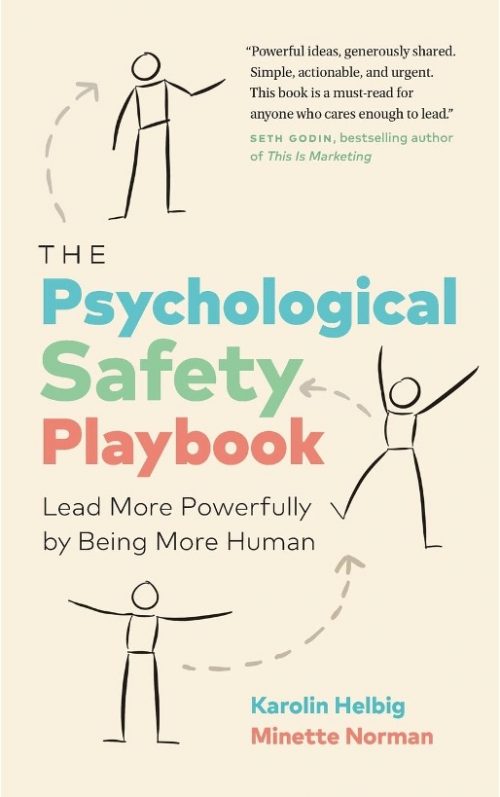
This is exactly what Karolin Helbig and Minette Norman describe in The Psychological Safety Playbook: that welcoming other viewpoints isn’t a grand gesture — it’s a disciplined, repeatable practice that any leader can start today.
Listening Is a Leadership Skill
Here’s an uncomfortable truth: most of us listen to respond, not to understand. While someone else is speaking, we’re quietly assembling our counterargument.
The Psychological Safety Playbook names this habit directly and offers a deceptively simple alternative — develop the discipline of not preparing a response while someone else is talking. Listen with the sole intent of understanding.
This single shift — practiced consistently, in meeting after meeting — tells your team that their thinking matters. That changes how people show up. And when people show up differently, culture shifts.
The Pause That Changes Everything
We’ve all experienced it — that moment when a colleague challenges our idea and something in us tightens. The amygdala fires. The fight-or-flight response kicks in. And before we know it, we’ve reacted in a way that shuts down exactly the kind of candid exchange we said we wanted.
Psychological safety at work erodes in moments like these. And it’s rebuilt the same way — one moment at a time.
Hitting the pause button before responding is a small action with an outsized impact. When leaders model non-defensive reactions consistently, they give their teams permission to do the same. The culture learns from watching what leaders do when they’re challenged, not from reading what the values statement says.
Naming Failure Before It Happens
Innovation requires risk. Risk requires safety. And safety — particularly around failure — has to be explicitly created, not assumed.
Something as simple as saying, “This is new to us, so we will make mistakes” before a team takes on a challenging project reframes the entire endeavor. It tells people that stumbling isn’t a career risk — it’s an expected part of the process. That one sentence, repeated consistently, normalizes learning over blame and accelerates the kind of experimentation that drives real results.
Who’s Holding the Door Open in Your Meetings?
In most meetings, a handful of voices dominate. The rest of the room — full of perspectives, ideas, and concerns — stays quiet. Not because they have nothing to contribute, but because the conditions aren’t right for them to speak.
Appointing an Inclusion Booster — someone whose explicit role is to invite quieter voices, minimize interruptions, and create space for dissenting views — is a structural change that costs nothing and changes everything. It’s a small action that systematically expands who gets heard.
The Ripple Effect of Psychological Safety at Work
None of these actions is complicated. None requires a budget approval or a change management framework. They require only consistency — the willingness to keep showing up, keep asking, keep pausing, keep naming, keep inviting.
That consistency is what creates ripples. One leader’s behavior influences a team. That team’s norms influence adjacent teams. Adjacent teams shift organizational culture.
This is how culture actually changes. Not through declarations, but through practice.
Ready to build psychological safety at work in your organization?
I’m a certified facilitator of the Psychological Safety Playbook.
And I work closely with leaders and their teams as they move through change.
I’d love to connect. Get in touch.
Learn about further resources from The Psychological Safety Playbook.