
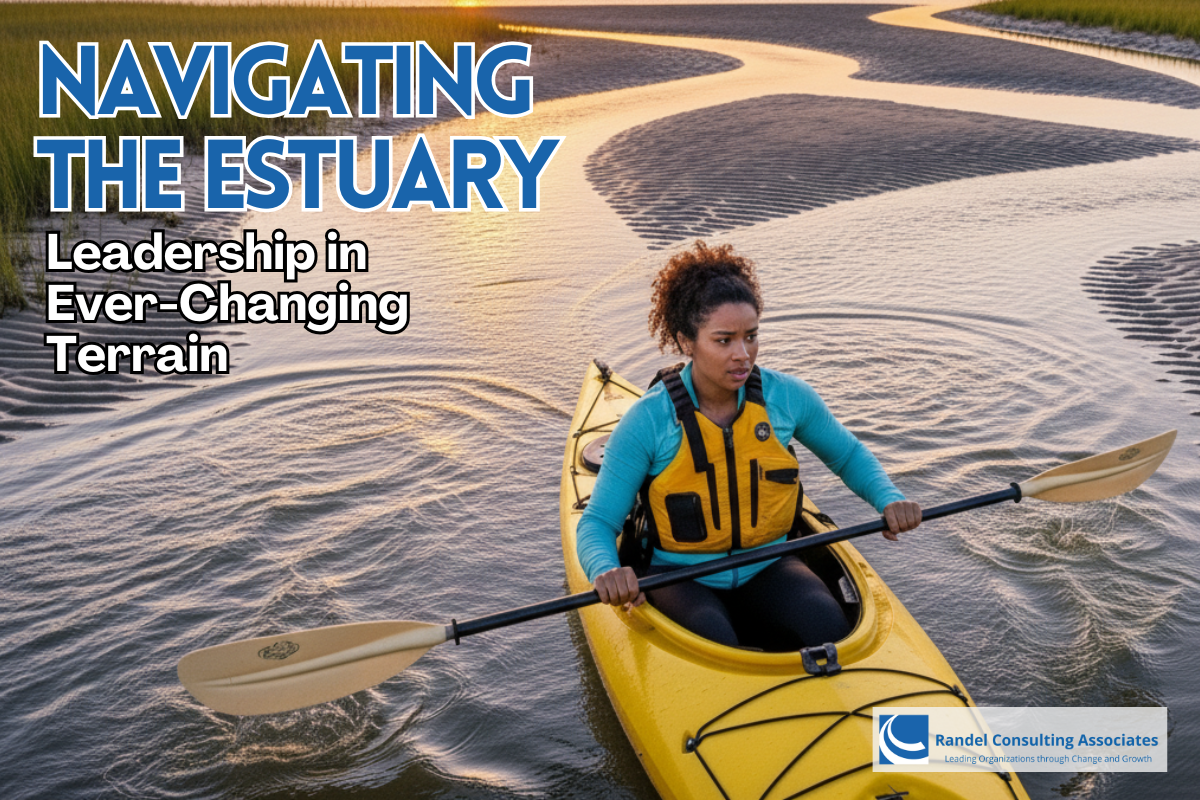
How accomplished leaders can guide their teams through constantly shifting organizational landscapes
Dear Change Leader,
“I feel like I’m kayaking through an estuary where the channels keep shifting,” shared Rebecca, a seasoned C-suite executive, during our recent conversation. “Just when I think I’ve found the safe passage, the tide changes and suddenly I’m navigating completely different waters.”
Her words captured something I’ve heard from other leaders this year. You’ve likely felt it too—that disorienting sense of leading when familiar channels disappear with each tide, and yesterday’s reliable route becomes today’s dead end.
If you’re reading this in early September, you’ve probably spent the summer trying to recalibrate after an intense first half of the year. Perhaps you’ve had moments where the way forward seemed clear, only to discover that the organizational landscape had shifted again beneath you.
Here’s what I’ve learned from working with leaders like Rebecca: the challenge isn’t that your navigation skills have failed. It’s that the tools and reference points on which you have traditionally relied are not suited to an environment that’s inherently dynamic.
When Traditional Navigation Meets Tidal Reality
Think about kayaking through a river estuary—that complex zone where fresh water meets salt water, where tides ebb and flow twice daily, where seasonal rains can reshape channels overnight. Some features remain relatively stable: the overall geography, the deeper channels, and the general flow toward the sea. But the specifics—water levels, current strength, passable routes—shift constantly.
Traditional organizational leadership assumes more stable terrain. Your strategic plans are like detailed maps, drawn when conditions were different. Your past experience is like a compass that worked perfectly in calmer waters but can be thrown off by the magnetic anomalies of unprecedented disruption. Even your real-time data—your organizational GPS—tells you where you are right now, but can’t predict what the changing tides will reveal around the next bend.
Most leaders respond to this uncertainty by either gripping tighter to outdated maps or abandoning navigation altogether. Both approaches miss something crucial: estuarine navigation requires a different skillset entirely.
The Estuarine Leader’s Approach
Navigating successfully through an estuary doesn’t require you to gather all available information, nor does it depend on you eliminating all uncertainties. What it does rely on is that you develop the capacity to read the waters, adapt to changing conditions, and guide your team safely through terrain that’s constantly being reshaped.
This requires developing three interconnected capabilities:
- Current Reading: Like an experienced kayaker who can read subtle water patterns to understand what lies beneath and ahead, leaders need to hone their sensitivity to organizational and environmental currents—the cultural shifts, resource flows, and stakeholder dynamics that shape the terrain.
- Adaptive Positioning: Rather than fighting the tide, skilled paddlers work with natural forces while maintaining their desired direction. Leaders become adept at knowing when to push forward, when to wait for better conditions, and when to find alternative channels.
- Crew Communication: In shifting waters, your team can easily become dispersed. Regular updates about conditions, intentions, and course corrections keep everyone moving in the same direction. Clear, frequent communication is essential when the landscape itself can’t be relied upon for reference points.
Three Practices for Estuarine Leadership
Here are practical approaches you can implement immediately to strengthen your dynamic navigation skills:
- Weekly Scanning
Each week, block time for scanning the organizational “tide”: What’s the energy level? Where do you feel momentum or resistance? What subtle signals suggest changing conditions ahead?
This isn’t formal analysis—it’s developing your intuitive sense of organizational currents.
- Monthly Course Correction
Regularly ask your team: “What are we learning about the terrain we’re navigating? Where do we need to adjust our approach based on changing conditions?”
This creates regular opportunities to adapt without abandoning your ultimate destination.
- Quarterly Channel Assessment
Once a quarter, step back and evaluate: “Does our route remain viable? What new passages are opening up? Where are we seeing persistent obstacles that suggest we need a different approach entirely?”
Your Estuary Challenge
Over the next month, try approaching your leadership role as an estuary navigator. Instead of asking “What’s the right strategy?” ask “How do I scan changing conditions and adapt our approach, whilst maintaining our essential direction?”
Pay attention to what happens when you shift from fighting the uncertainty to working skillfully with it. Sometimes the most direct path forward emerges not from having better maps, but from developing better skills for reading the water you’re actually in.
The tides of change aren’t slowing down. But by approaching leadership in this way, you can learn to use these forces to carry your team toward your destination more effectively than ever.
Until next time,

Coming Next Week: The Optimism Toolkit
Why start with optimism? Because in today’s challenging environment, optimism isn’t just a nice-to-have personality trait—it’s a strategic leadership competency. Leaders who can maintain and cultivate optimism create conditions for breakthrough thinking, team resilience, and sustained performance.
The first issue includes:
✓ Why Leaders Need Optimism to Survive Tough Times
✓ The Leader’s Optimism Assessment
✓ Guided Readings on Optimism and Resilience
✓ A Team Exercise for cultivating collective optimism
Ready for practical leadership tools delivered monthly?
Subscribe to Leadership In Action on LinkedIn
Leadership isn’t just about awareness—it’s about taking informed action.
EFFECTIVE CHANGE RESULTS FROM INTENTIONAL LEADERSHIP
We’re a leadership and organization development consultancy. My team and I work with leaders like you to prepare for and lead successful change processes.
Here’s why our clients call us:
- Leadership Coaching: I support leaders as they navigate transitions into new roles or expanded responsibilities.
- Group Coaching and Learning Programs: Bringing groups of leaders together, I facilitate learning experiences and months-long programs that equip people to be effective change leaders.
- Effective Teams and Stronger Organizations: I work with leaders and their teams with tailored processes that increase their effectiveness, building layers of aligned teams that transform organizations.