
Peak performance can be a warning sign. Here’s how to read it before the slide begins.

Dear Change Leader,
Let me ask you a question that might be uncomfortable: Is your current success setting you up for future decline?
Sit with that for a moment.
It sounds counterintuitive. Things are working. People are delivering. The metrics look reasonable. But underneath the day-to-day momentum, something feels slightly off. Growth has plateaued. The energy that used to propel the team feels a little flatter. The strategy that worked brilliantly two years ago feels like it’s running out of road.
Sound familiar?
If it does, you may be at one of the most critical — and most overlooked — moments in the life of any organization: the point just before a peak, when renewal is still possible, but the window is beginning to close.
The Sigmoid Curve: A Map for Where You Are
There’s a concept I return to again and again with the leaders I work with. I first learnt it from the management writer Charles Handy, who described the lifecycle of organizations using what’s called a Sigmoid Curve — essentially an S-shaped arc that traces growth, peak performance, and eventual decline.
Every team, department, and organization follows some version of this arc. You launch, you struggle, you find your footing, you grow, you peak — and then, if nothing changes, you begin to decline.
Here’s the paradox: the very habits, models, and mindsets that drove your growth are often the ones that accelerate your decline. What got you here won’t get you there.
Handy’s brilliant insight was this: the best time to launch a new curve — to renew and reinvent — is before you’ve peaked. Not when you’re in freefall and desperate, but while you still have the energy, resources, and credibility to invest in something new.
But there’s a big problem in operationalizing this insight… It’s almost impossible to identify when the moment has arrived from the inside. When things are going well, there’s little appetite for disruption. When the early signs of decline appear, it often feels too soon to panic — and by the time it’s obvious, it may be too late to act with confidence.
Three Signs You May Be Closer to the Peak Than You Think
You don’t need a crisis to start asking better questions. Watch for these signals:
- Your answers feel more comfortable than your questions. When was the last time your leadership team surfaced a genuinely difficult question about your direction — and sat with it, rather than quickly resolving it? If your planning conversations feel smooth and settled, that’s worth examining. Healthy organizations stay a little restless.
- You’re optimizing rather than exploring. There’s a difference between getting better at what you already do and experimenting with what you could do next. If your improvement efforts are all about efficiency — doing the same things faster or cheaper — and there’s very little investment in new ideas, you may be harvesting rather than planting.
- The external environment has shifted, but your internal assumptions haven’t. Your strategy is always built on assumptions — about your clients, your competitors, your resources, your relevance. When did you last test those assumptions against what’s actually happening around you? If the world has moved but your operating model hasn’t, the gap is growing whether you see it or not.
https://rcachangeadvisors.com/blog/renewal-innovation-and-the-sigmoid-curve/
This Week: Start the Conversation
You don’t need a strategic offsite or a consultant to begin. You need one honest conversation.
Gather a small group — your leadership team, a few trusted advisors, or even a handful of people who will tell you what you need to hear rather than what you want to hear. Ask them:
“If we were starting fresh today — with everything we know now — would we build what we currently have? And if not, what would we do differently?”
Don’t rush to answer. Listen for what the question surfaces. The discomfort it creates is exactly the information you need.
The goal isn’t to tear down what’s working. It’s to ensure you’re investing in what comes next while you still have the capacity to do so. Renewal isn’t a sign of failure — it’s the mark of a leader who’s paying attention.
Until next time,

P.S. If this question is sitting uncomfortably with you — or if you sense your organization may be further along the curve than you’d like — I’d welcome a conversation. Sometimes the most valuable thing is simply having a thinking partner who can help you see what’s hard to see from the inside. [Reply to this email or click here to set up a time to talk.]
A New Resource for You!
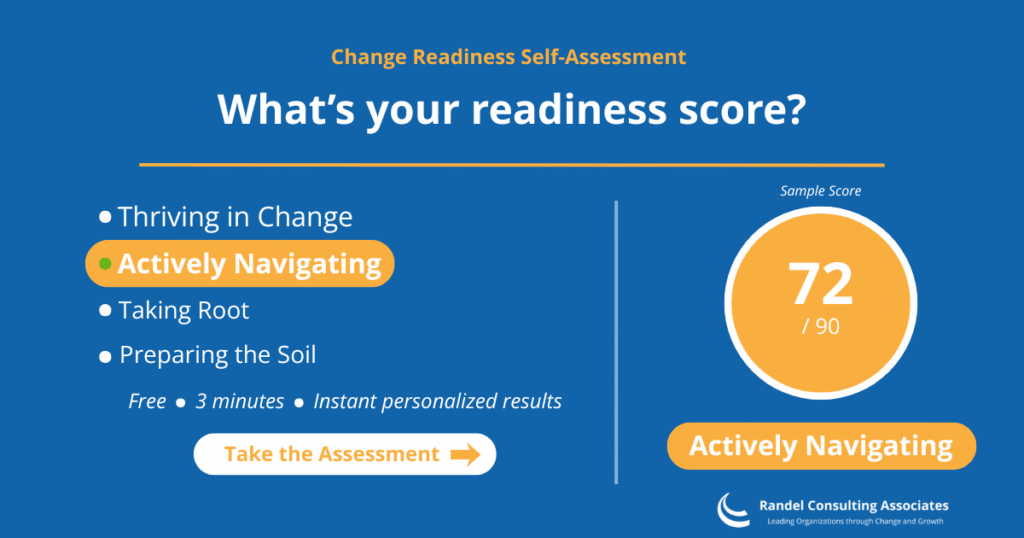
How Ready Is Your Organization for Change?
The newsletter you just read poses a challenging question: Are you acting early enough to renew before the decline begins?
If you’re not sure where to start, I’ve created a free tool that can help.
The Change Readiness Self-Assessment takes about 3 minutes and gives you a personalized profile of your organization’s readiness across the three phases of change: Prepare, Cultivate, and Harvest — the same framework I use with the leaders I work with every day.
You’ll finish with a clear picture of where your organization is strong, where the gaps are, and practical actions you can take right now.
Know someone who should take this, too? Share it with a colleague — it’s even more useful when a team compares results together.
EFFECTIVE CHANGE RESULTS FROM INTENTIONAL LEADERSHIP
We’re a leadership and organization development consultancy. My team and I work with leaders like you to prepare for and lead successful change processes.
Here’s why our clients call us:
- Leadership Coaching: I support leaders as they navigate transitions into new roles or expanded responsibilities.
- Group Coaching and Learning Programs: Bringing groups of leaders together, I facilitate learning experiences and months-long programs that equip people to be effective change leaders.
- Effective Teams and Stronger Organizations: I work with leaders and their teams with tailored processes that increase their effectiveness, building layers of aligned teams that transform organizations.