
Dear Change Leader,
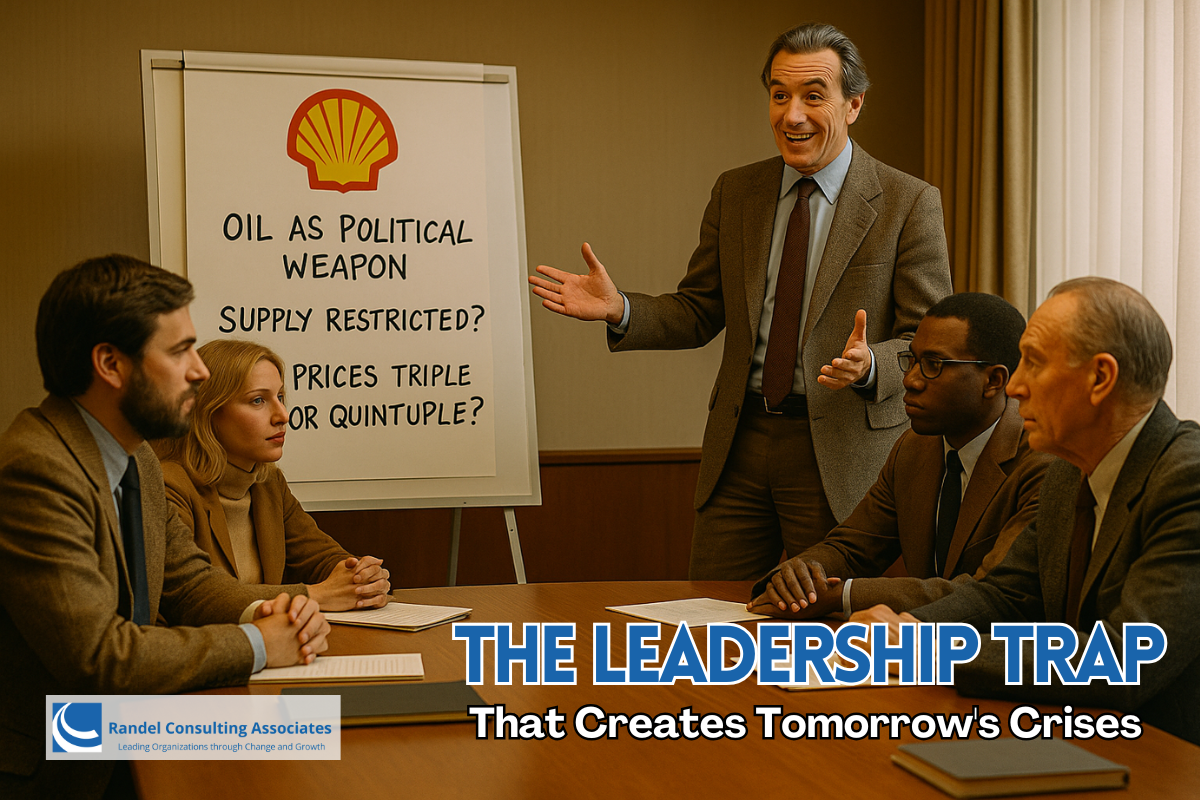
In 1972, a small team at Royal Dutch Shell gathered to do something that seemed almost absurd: imagine a future in which oil prices would skyrocket.
At the time, oil had been cheap and stable for decades. The entire industry operated on the assumption that this would continue. Planning for anything else felt like an academic exercise—interesting, perhaps, but hardly urgent when there were quarterly targets to meet and operations to manage.
But Shell’s planning team, led by Pierre Wack, insisted on exploring scenarios that felt uncomfortable, even implausible. What if Middle Eastern countries decided to use oil as a political weapon? What if supply could be suddenly restricted? What if prices tripled—or quintupled?
Most oil executives considered such scenarios too far-fetched to warrant serious attention. After all, there were real, present-day challenges demanding their focus.
Then came October 1973. The Arab oil embargo hit, and prices quadrupled almost overnight. The industry was thrown into chaos.
Except for Shell.
Because they had already explored this scenario—asked the hard questions, worked through the implications, identified the decisions they would need to make—Shell responded with a speed and clarity their competitors couldn’t match. Within two years, they moved from being one of the weakest of the major oil companies to one of the strongest.
The difference? While their competitors had been entirely focused on present operations, Shell had maintained a relationship with the future.
The Hidden Cost of Living Only in the Present
Shell’s story illustrates what I call temporal discounting—the leadership trap of consistently prioritizing today’s urgencies over tomorrow’s necessities.
When everything feels urgent, the future becomes an abstraction—something we’ll deal with “when things calm down.” The problem? Things rarely calm down. And the future arrives whether we’re ready or not.
Temporal discounting shows up in familiar patterns:
- Strategic planning sessions are repeatedly postponed for “more urgent” matters
- Professional development is viewed as a luxury rather than a necessity
- Scenario planning is treated as academic rather than practical
- Partnership building delayed until there’s “more bandwidth”
- Market scanning is relegated to “when I have a chance”
None of these feels urgent today. But their absence creates crises tomorrow.
The paradox? Leaders who feel they don’t have time to prepare for the future often end up spending far more time managing crises that could have been prevented through preparation.
Why Even Smart Leaders Discount Tomorrow
This isn’t a failure of intelligence or commitment. It’s how our brains are wired.
Present challenges trigger immediate emotional and neurological responses. They activate our stress systems, demanding attention now. Future challenges, no matter how significant, don’t trigger the same urgency. They remain cognitive abstractions until they become present crises.
Organizational processes inadvertently reinforce this pattern. Most reward systems recognize visible action on current problems. Few value and reward the quiet work of preparing for challenges that never materialize because someone prepared well.
The result? Leaders know intellectually they should invest in the future, but their daily experience constantly pulls them back to the present.
Three Practices for Reclaiming the Future
The solution isn’t working harder or finding more time. It’s establishing routines that systematically redirect attention toward what’s coming:
- The Monthly Horizon Scan
Set aside 90 minutes monthly to ask: “What’s emerging in our environment that could fundamentally shift our landscape in 12-24 months?”
- Review industry publications, regulatory announcements, and competitor movements
- Note patterns across seemingly unrelated developments
- Identify one emerging trend deserving deeper exploration
- Document your observations; review patterns quarterly
Why it works: By scheduling this consistently, you transform future-scanning from something you’ll “get to eventually” into a regular discipline. The practice trains your mind to notice signals you’d otherwise miss.
- The Quarterly Capacity Investment
Every quarter, identify one capability your organization will need in the future but lacks today. Invest specifically in building that capacity—whether through training, hiring, partnerships, or systems.
- Ask: “What skills or capabilities will tomorrow’s challenges require?”
- Choose one area for focused development this quarter
- Allocate budget and time as you would for any operational priority
- Track progress with the same rigor as operational metrics
Why it works: This shifts future preparation from abstraction to concrete action. By treating it as a regular operational priority, you ensure consistent investment even during busy periods.
- The Weekly Strategic Question
Start each week by asking one forward-looking question about your organization’s direction, positioning, or preparedness. Spend just 15 minutes considering it—no need for immediate answers.
Examples:
- “What assumption are we making about our market that could be wrong?”
- “Which of our current strengths might become less relevant?”
- “Where are we vulnerable to disruption we haven’t discussed?”
- “What partnerships could position us for emerging opportunities?”
Why it works: Regular exposure to strategic questions keeps your thinking calibrated toward the future without requiring huge time blocks. Over weeks, patterns emerge that inform better decisions.
Your Two-Week Challenge
Choose one of these practices and commit to it for the next two weeks:
- If you’re constantly firefighting: Try the Weekly Strategic Question to rebuild your future-thinking muscle
- If you sense something’s shifting but can’t focus on it: Conduct one Horizon Scan exercise
- If you worry your team lacks future capabilities: Identify one area for Quarterly Capacity Investment
The goal isn’t perfection—it’s interrupting the pattern of temporal discounting with deliberate attention to what’s coming.
Notice what changes when you create even small, consistent space for the future in your present.
Remember: Shell didn’t avoid the oil crisis of 1973. But they were ready for it. The organizations that thrive through change aren’t lucky—they’re the ones whose leaders refused to let urgency completely crowd out preparation.
Until next time,

P.S. The practice Shell pioneered—scenario planning—isn’t just for global corporations. The principle applies at every scale: regularly exploring plausible futures helps you recognize and respond when one becomes reality. If you’d like to explore how to build these practices into your leadership routine, I’d welcome a conversation.
Leading through Growth and Change
Read other editions of this newsletter for further insights:
- “When the World Goes Through The Shredder” invites you to navigate uncertainty by starting in the present and creating experiments.
- “Leading Through Complexity: Embrace the Messy Middle” will help you in making sense of where things stand in the present moment.
- “The Pathfinder Approach: Leading When You Can’t See The Full Trail” offers ideas to help you probe for ways to move towards your goal.
- “Finding Renewal In Destruction: The Forest Fire Principle Of Resilience” supports you in building a strong ground from which to recover from disruption.
EFFECTIVE CHANGE RESULTS FROM INTENTIONAL LEADERSHIP
We’re a leadership and organization development consultancy. My team and I work with leaders like you to prepare for and lead successful change processes.
Here’s why our clients call us:
- Leadership Coaching: I support leaders as they navigate transitions into new roles or expanded responsibilities.
- Group Coaching and Learning Programs: Bringing groups of leaders together, I facilitate learning experiences and months-long programs that equip people to be effective change leaders.
- Effective Teams and Stronger Organizations: I work with leaders and their teams with tailored processes that increase their effectiveness, building layers of aligned teams that transform organizations.