
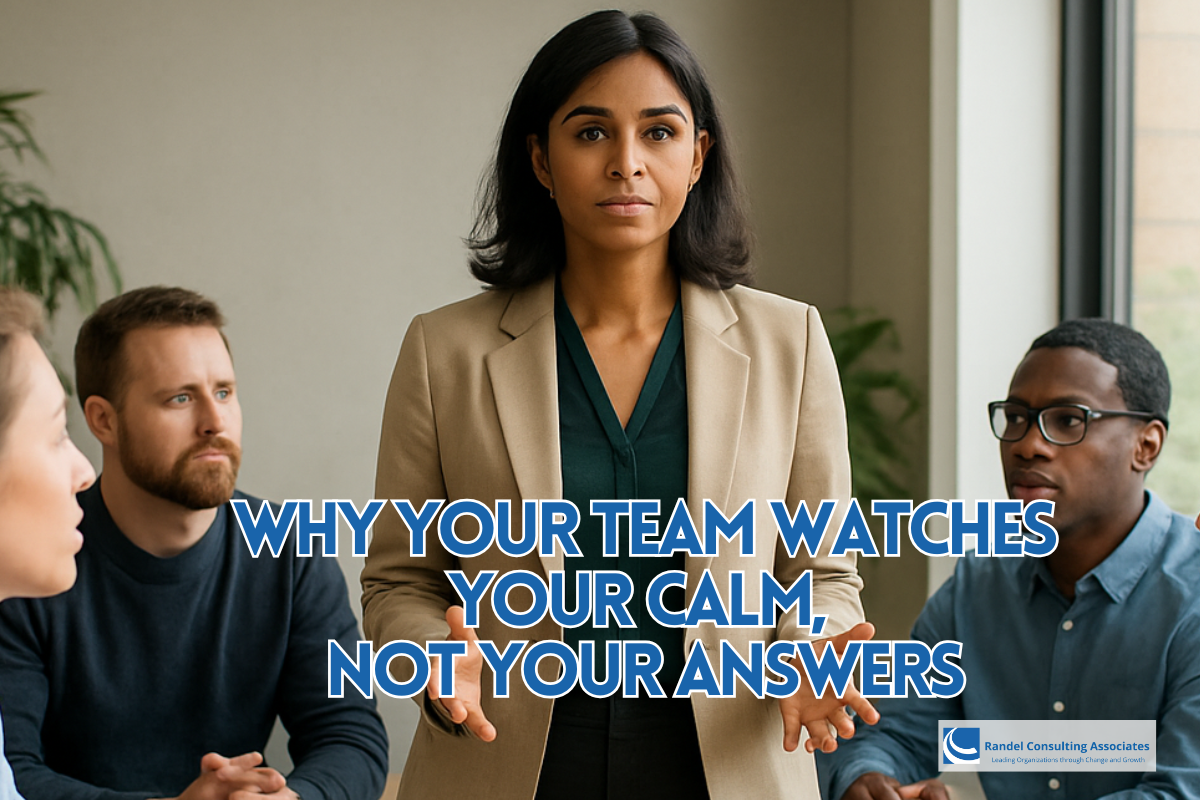
Leading with presence when you don’t have all the solutions
Dear Change Leader,
“I need to have the answer before I can talk to my team,” Jennifer said during a recent call.
As a senior leader, she’d been dealing with shifting customer demands and three rounds of budget revisions in the past six months. Each new challenge brought questions she couldn’t immediately answer.
“If I go to them without a clear plan,” she continued, “they’ll think I don’t know what I’m doing. They need to see I have it under control.”
But here’s what Jennifer was missing: her team already knew she didn’t have all the answers. They were living the same uncertainty she was.
What they were really watching wasn’t whether she had solutions—it was how she showed up while figuring them out.
The Leadership Paradox of 2025
This year has tested every leader I know. The traditional leadership playbook—analyze the situation, develop a strategy, communicate the plan with confidence—has too often fallen short. By the time you’ve completed your analysis, the situation has changed again.
What does your team need from you right now?
Most leaders assume their teams need answers, certainty, and clear direction. While those things matter, in volatile times your team needs something else even more urgently—they need to see that you can remain centered when the ground is shaking.
They’re not primarily watching what you know. They’re watching how you are.
What Calm Actually Looks Like
Let’s be clear about something important: calm isn’t the same as having answers. It’s not about projecting false confidence or pretending everything’s fine when it’s not.
Calm is the quality of remaining present and responsive in the face of difficulty. It’s the capacity to acknowledge challenges without being overwhelmed by them. It’s being able to say “I don’t know yet” without panic in your voice.
Three Practices for Leading with Calm
Here are approaches to help you maintain your steadiness while navigating ongoing uncertainty:
1. Separate “I Don’t Know” from “We Can’t Figure This Out”
Not having immediate answers doesn’t mean you’re failing as a leader. It means you’re dealing with genuinely complex situations. When you next face an uncertain situation, begin by clearly distinguishing between what you know, what you don’t know, and what you’re doing to learn more. Notice how this clarity itself creates a sense of steadiness.
What this looks like:
- “I don’t have a final answer yet, and here’s how I’m thinking about it…”
- “We’re dealing with several unknowns right now. Let me share what we do know and what we’re still learning…”
- “This situation is evolving faster than we can plan for. Here’s our approach for staying responsive…”
Tend to Your Own Nervous System
You cannot project the calm you don’t possess. If you’re chronically dysregulated—running on adrenaline, stress, and coffee—your team will feel it regardless of what you say.
What this looks like:
- Taking genuine breaks, even brief ones, throughout your day
- Physical practices that help you discharge stress (walking, exercise, even deep breathing between meetings)
- Boundaries that protect your recovery time
- Honest conversations with peers or a coach about your own challenges
3. Name Reality Without Adding Alarm
Your team can handle difficult truths. What destabilizes them is when they sense you’re hiding something or when you deliver bad news in a way that suggests panic.
What this looks like:
- Acknowledging challenges directly: “This is difficult, and we’re going to work through it.”
- Sharing your reasoning: “Here’s why we’re making this decision, even though it’s not ideal…”
- Being honest about trade-offs: “We can’t do everything, so we’re prioritizing…”
- Maintaining perspective: “This is hard right now, and we’ve navigated hard things before.”
What Changes When You Lead with Calm
Three months after our initial conversation, Jennifer shared what happened when she shifted her approach.
“I started bringing my team into my thinking process earlier—sharing what I was considering, what I was uncertain about, what I was learning,” she told me.
Her team didn’t lose confidence. Instead, they became more engaged, offering insights she hadn’t considered and taking more ownership of finding solutions.
“The biggest shift,” she reflected, “was realizing that my job isn’t to absorb all the uncertainty so they don’t have to feel it. My job is to model that we can navigate uncertainty together without falling apart.”
That’s the leadership this moment requires—not having all the answers, but having the steadiness to figure them out alongside your team.
Until next time,

P.S. The capacity to remain calm under pressure isn’t something you either have or don’t have—it’s a skill that develops with practice. If you’re finding it hard to maintain your center while everything around you keeps shifting, I’d welcome a conversation about building these practices into your leadership routine.
Friday Leadership Lab
I’m hosting a weekly drop-in Coaching and Conversation for Leaders on Fridays from now until the end of the year.
Join me for an upcoming session where leaders are encouraged to bring their real challenges, questions, and curiosities.
Leaders: What if you had a trusted advisor you could turn to every Friday?
I’m opening up the Friday Leadership Lab – free weekly drop-in coaching at 2pm Eastern.
Bring a challenge you’re working through. Ask about a difficult conversation. Share what’s keeping you up at night. Or just listen and learn from other leaders.
In 30+ years of guiding leaders through uncertainty, I’ve found that what helps most is a calm space to think clearly and move forward with confidence.
No crisis required. No long-term commitment.
Register once and drop in whenever you need support.
EFFECTIVE CHANGE RESULTS FROM INTENTIONAL LEADERSHIP
We’re a leadership and organization development consultancy. My team and I work with leaders like you to prepare for and lead successful change processes.
Here’s why our clients call us:
- Leadership Coaching: I support leaders as they navigate transitions into new roles or expanded responsibilities.
- Group Coaching and Learning Programs: Bringing groups of leaders together, I facilitate learning experiences and months-long programs that equip people to be effective change leaders.
- Effective Teams and Stronger Organizations: I work with leaders and their teams with tailored processes that increase their effectiveness, building layers of aligned teams that transform organizations.