
Dear Change Leader,
Marcus could be counted on to see the solution before anyone else in the room.
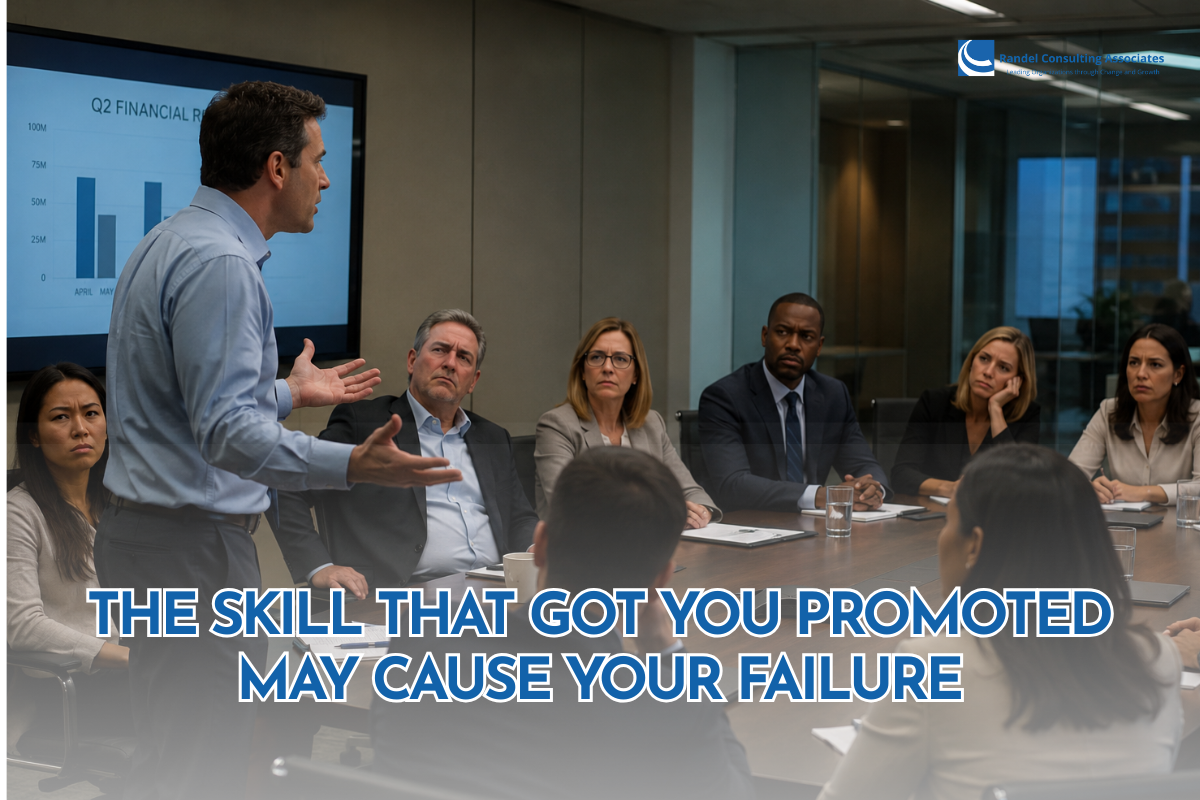
As SVP of Operations in a national retailer, he’d built his entire career on his ability to cut straight to what mattered in a messy situation. It’s why he’d been promoted three times in six years. His analysis was sharp, his recommendations were sound, and for most of his career, that had been enough. Say the smart thing, and the room came along.
So when he proposed consolidating two regional supply chains — a move that would save millions and reduce risk — he expected the usual response: head nods, some clarifying questions, a green light.
Instead, he got silence during the meeting, followed by resistance afterward. Not because the analysis was wrong. Nobody could find a hole in it. But two peers slow-walked their input, while a key director raised “concerns” that sounded more territorial than substantive. The initiative stalled for months, bruising Marcus’s reputation as a leader.
Marcus hadn’t lost his edge. He’d just discovered that being right in the wrong way might prove to be a career killer.
The Shift Nobody Warns You About
Here’s the dynamic: the higher you rise in the company hierarchy, the less your influence relies on the strength of the idea alone. At senior levels, most consequential decisions touch other people’s turf, budgets, and priorities. Getting to “yes” now requires something your technical brilliance viewed as a ‘nice to have’ — a network of relationships with whom you have already built trust you before you need something from them.
This is a hard transition for a very particular reason: the expertise that got you promoted can blind you to your influence gaps. When you’ve always relied on your sharpness, it’s easy to read resistance as other people being slow, political, or wrong. And can be hard to read subtle signals when your relational capabilities haven’t caught up to your role.
Network building isn’t an optional soft skill bolted onto “real” leadership. Your network is the delivery mechanism for everything else you’re good at.
Three Ways to Build Your Network – Before You Need It
- Map your web before you need to use it.
Most leaders only think about stakeholders when they’re already pushing a specific initiative — which means they’re starting relationships while under pressure, the worst possible moment to do so. Instead, identify 8–10 people whose support you’ll likely need over the next year, regardless of what you’re proposing. Peers in other functions, a board member, someone two levels up you don’t report to.
This week: Pick one name from that list you haven’t spoken with in months, and reach out with no agenda — just genuine interest in what’s on their plate. - Trade in currency before you need to spend it.
Influence works like a bank account, not a light switch. You build balance by being useful to others when nothing is in it for you — sharing information, making a helpful introduction, backing someone else’s initiative publicly. People remember who showed up for them before they were asked to show up for you.
This week: Find one small, genuine way to be useful to a peer with no immediate ask attached. - Treat “no” and silence as data, not defeat.
When Marcus’s proposal stalled, his instinct was to sharpen the analysis further. That was solving the wrong problem. Resistance at senior levels is rarely about the facts — it’s usually about unaddressed concerns, unspent trust, or someone feeling bypassed. Get curious about what’s underneath the pushback instead of just re-arguing your case.
This week: The next time you hit unexpected resistance, ask the person directly: “Help me understand what’s giving you pause” — and actually listen to the answer.
Back to Marcus
When Marcus finally slowed down enough to ask his two resistant peers what was really going on, he learned something his analysis had never surfaced: one felt blindsided by not being consulted earlier, and the other was quietly worried about how the change would land with her own team. Neither objection showed up in a spreadsheet. Both were solvable — once he knew they existed.
The supply chain consolidation was revisited and eventually went through. But only once Marcus made a shift himself: he stopped treating relationship-building as a distraction from the real work, and started treating it as the real work.
Until next time,

P.S. If you’re finding that your best ideas are landing with more resistance than they used to, it might not be the ideas. I work with senior leaders — one-on-one and in facilitated peer groups — on exactly this kind of relational recalibration. Reply to this email if you’d like to talk it through.
Recent Articles
Read other editions of this newsletter for further insights:
- “Measure Twice, Change Once” walks through the four foundational moves of successful change, including mobilizing stakeholders before launch — the same “build the relationship before you need it” principle Marcus learns the hard way.
- “The Leadership Trap That Creates Tomorrow’s Crises” explores how leaders discount future needs in favor of urgent demands, a pattern that shows up here too: network-building gets deferred until the moment you desperately need the network already built.
- “Seeing the Systems That Enable Everything” shows how the leaders who move from feeling stuck to finding real leverage are the ones who stop hunting for a single cause and start seeing the web of connections around them — exactly the shift Marcus makes when he finally asks his peers what’s really going on instead of re-arguing his data.
EFFECTIVE CHANGE RESULTS FROM INTENTIONAL LEADERSHIP
We’re a leadership and organization development consultancy. My team and I work with leaders like you to prepare for and lead successful change processes.
Here’s why our clients call us:
- Leadership Coaching: I support leaders as they navigate transitions into new roles or expanded responsibilities.
- Group Programs: Bringing groups of leaders together, I facilitate learning experiences and months-long programs that equip people to be effective change leaders.
- Effective Teams and Organizations: I work with leaders and their teams with tailored processes that increase their effectiveness, building layers of aligned teams that transform organizations.