
Dear Change Leader,
Renata had made it through.
As Executive Director of a regional literacy nonprofit, she’d spent the past year absorbing one hit after another: a major funder pulled back mid-grant cycle, two staff positions went unfilled after departures, and the remaining team quietly picked up the slack because the programs still needed to run. Nobody missed a deadline. No sites closed.
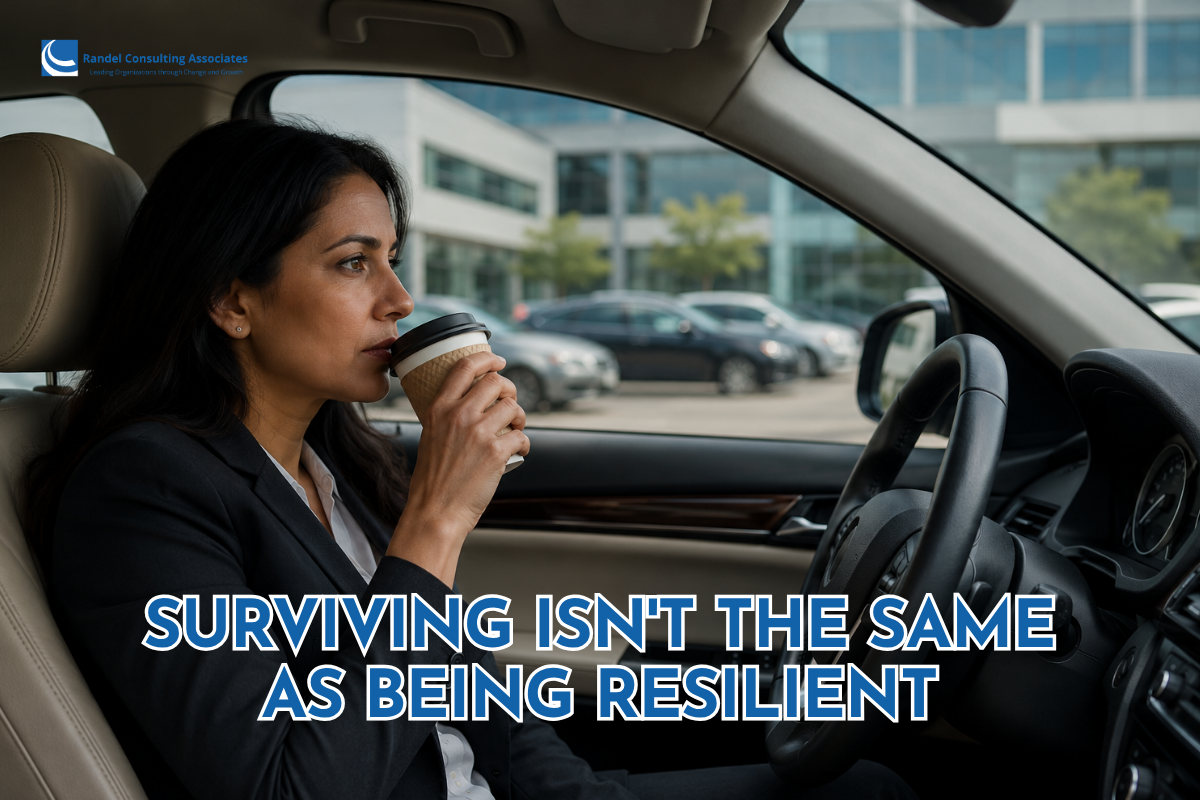
At her board meeting, a trustee praised the team’s resilience. Renata smiled and said thank you. But walking to her car afterward, the word sat wrong with her.
Her team hadn’t recovered from anything. They’d just kept going.
Enduring Isn’t the Same as Being Resilient
It’s an easy mistake to make, because from the outside they look identical — the organization is still standing either way. But they’re built differently, and the difference shows up later, not now.
Endurance is getting through a hard stretch through sheer effort: people working longer, covering gaps, absorbing the strain personally. It produces the same short-term result as resilience — survival — without building any actual capacity to handle the next disruption.
Resilience is different. It’s the capacity to absorb a shock, adapt through it, and come out the other side functional, sometimes stronger, having built something durable from the experience.
The tell isn’t how an organization looks mid-crisis. It’s what it looks like going into the next one — more depleted and more fragile, or more capable than before. If your team is running on fumes right now, that’s not a character flaw. It’s useful information about which one you’re currently doing.
Three Ways to Move from Enduring to Resilient
- Name what’s actually happening — out loud.
Most teams don’t get a chance to distinguish endurance from resilience because no one names the difference. Praise for “how well everyone’s handling it” can quietly signal that the current pace is sustainable, when it isn’t. Your team needs to hear that you see the effort as a stopgap, not a new normal.
This week: Tell your team directly — not “I know it’s been a lot,” but “what we’re doing right now is endurance, not our steady state, and I’m working on what changes.”
- Protect a sliver of slack, even a small one.
Structural slack — capacity that isn’t fully allocated to daily operations — is often the first thing cut when budgets tighten, because it looks like waste until the moment it’s needed. You likely can’t rebuild a cushion overnight. But even a small deliberate buffer, protected on purpose, changes what happens when the next disruption hits.
This week: Identify one commitment, meeting, or “nice to have” deliverable you can pause for 30 days, and redirect that time toward margin rather than more output.
- Build in recovery — don’t just snap back.
When the crisis eases, the instinct is to immediately return to normal operating mode and treat the disruption as over. Resilient teams do something different first: they process it. What changed? What did we learn? What would we do differently? Skipping that step means the vulnerability that caused the strain is still sitting there, untouched, waiting for the next funding shock or departure to expose it again.
This week: Before adding anything new to your team’s plate, spend 20 minutes with them on one question: “What did the last few months teach us that we shouldn’t lose?”
Back to Renata
Renata didn’t have the budget to hire back the two positions, and she knew another funding cycle would bring its own surprises. But she did one thing differently: instead of moving straight into next quarter’s planning, she gathered her team for an hour and asked what they’d learned about their own limits, and about each other, over the past year.
What came out of that conversation surprised her. Two staff members had quietly been covering for each other in ways no one had formally acknowledged — a dependency that worked, until it wouldn’t. She built a cross-training plan around it before it became a crisis instead of after.
The funding picture hadn’t changed. But her organization had — from a team that was holding on, to one that was starting to build something that could hold up.
Until next time,

P.S. If you’re noticing your team is technically fine but running on reserves that aren’t refilling, that gap between enduring and actually recovering is exactly where I spend most of my time with clients. Simply reply to this email.
Recent Articles
Read other editions of this newsletter for further insights:
“Finding Renewal in Disruption“ explores why resilience isn’t about avoiding hard seasons but about what you build from them — the same reframe at the heart of Renata’s story, just traced through a different lens.
“The Bonds That Rebuild“ looks at relational resilience — how teams that pause to reconnect as people before rushing back to the plan end up stronger than teams that just push through, echoing the recovery step Renata’s team almost skipped.
“The Leadership Trap That Creates Tomorrow’s Crises“ examines how leaders discount future needs in favor of urgent demands — the same pattern that turns structural slack into the first thing cut, long before anyone notices what it cost.
EFFECTIVE CHANGE RESULTS FROM INTENTIONAL LEADERSHIP
We’re a leadership and organization development consultancy. My team and I work with leaders like you to prepare for and lead successful change processes.
Here’s why our clients call us:
- Leadership Coaching: I support leaders as they navigate transitions into new roles or expanded responsibilities.
- Group Programs: Bringing groups of leaders together, I facilitate learning experiences and months-long programs that equip people to be effective change leaders.
- Effective Teams and Organizations: I work with leaders and their teams with tailored processes that increase their effectiveness, building layers of aligned teams that transform organizations.